
Datasette Apps: Host custom HTML applications inside Datasette
GLM-5.2 is probably the most powerful text-only open weights LLM

In this newsletter:
Datasette Apps: Host custom HTML applications inside Datasette
GLM-5.2 is probably the most powerful text-only open weights LLM
Publishing WASM wheels to PyPI for use with Pyodide
Plus 5 links and 4 quotations and 7 releases and 1 TIL and 1 research report and 1 tool
Sponsor message: Is your agentic development stuck? It happens. Get back on track with Microsoft‘s Create an Agent MVP in 30 Days checklist. It’s the advice you need to go from idea to production to real customers and monetization. Download the checklist here.
Datasette Apps: Host custom HTML applications inside Datasette - 2026-06-18
Today we launched a new plugin for Datasette, datasette-apps, with this launch announcement post on the Datasette project blog. That post has the what, but I’m going to expand on that a little bit here to provide the why.
The TL;DR
Datasette Apps are self-contained HTML+JavaScript applications that run in a tightly constrained <iframe> sandbox hosted on your Datasette application. They can use JavaScript to run read-only SQL queries against data in Datasette, and can run write queries too if you configure them with some stored queries.
Here’s a very simple example and a more complex custom timeline example - the latter looks like this:
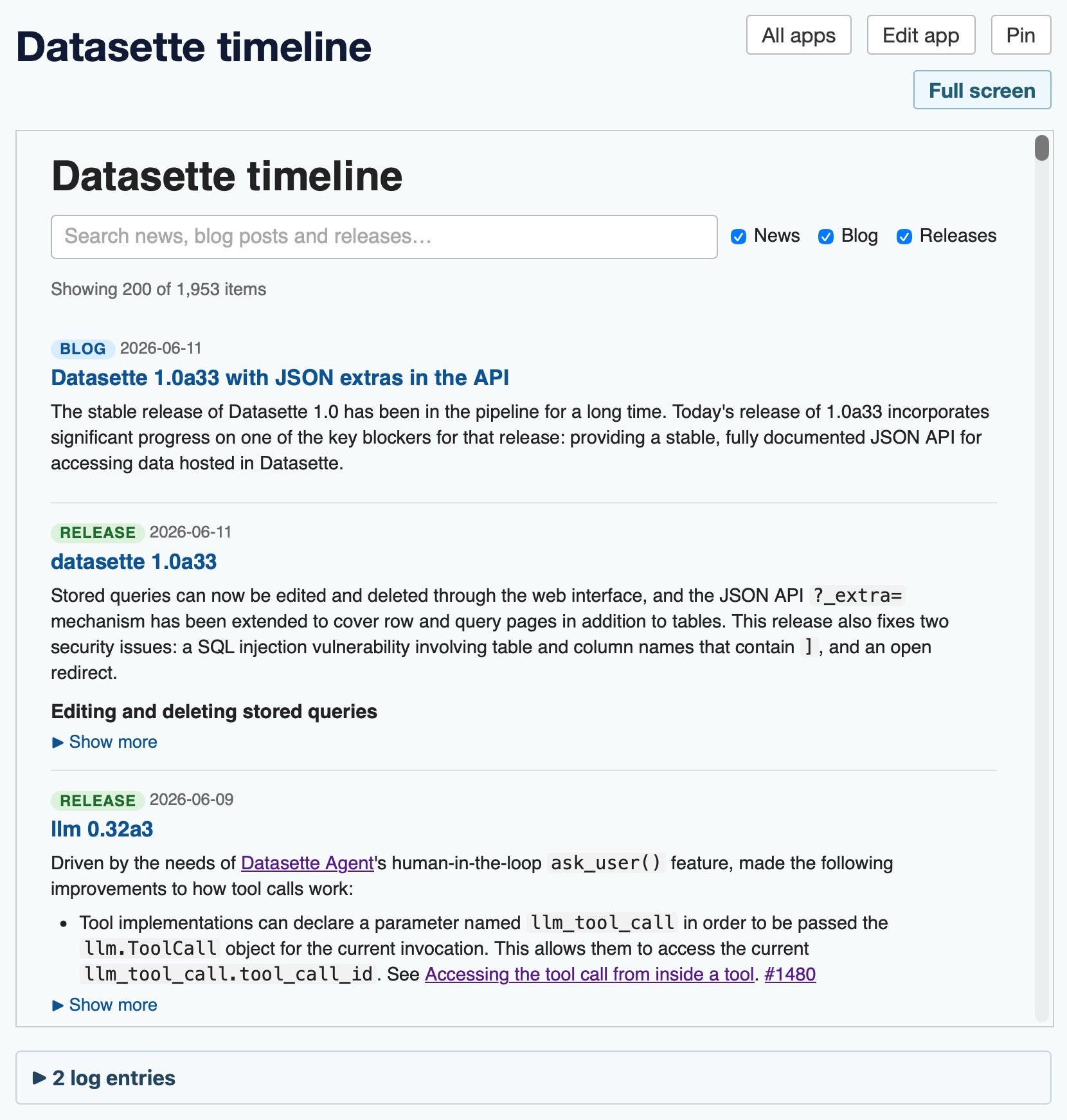
Apps are allowed to run JavaScript and render HTML and CSS. They are limited in terms of access - the <iframe sandbox="allow-scripts allow-forms"> they run in prevents them from accessing cookies or localStorage and they also have an injected CSP header (thanks to this research) which prevents them from making HTTP requests to outside hosts, preventing a malicious or buggy app from exfiltrating private data.
Datasette Apps started out as my attempt at building a Claude Artifacts mechanism for Datasette Agent, but I quickly realised that the sandboxed pattern is interesting for way more than just adding custom apps to the interface surface and promoted it to its own top-level concept within the Datasette ecosystem.
They’re also a fun way to turn my multi-year experiment in vibe-coded HTML tools into a core feature of my main project!
You can try out Datasette Apps by signing in with GitHub to the agent.datasette.io demo instance.
Why build this?
Since the very first release, Datasette has offered a flexible backend for creating custom HTML apps via its JSON API.
One of my earliest Datasette projects was an internal search engine for documentation when I worked at Eventbrite - it worked by importing documents from different systems into SQLite on a cron and then serving them through a Datasette instance with a custom HTML+JavaScript search interface that directly queried the Datasette API.
I had client-side JavaScript constructing SQL queries, which originally was intended as an engineering joke but turned out to be a really productive way of iterating on the app!
That project, combined with my experience building my HTML tools collection and my experiments with Claude Artifacts, has convinced me that adding a Datasette-style backend to a self-contained HTML frontend is an astonishingly powerful combination.
Imagine how much more useful Claude Artifacts could be if they had access to a persistent relational database. That’s what I’m building with Datasette Apps!
Neat ideas in Datasette Apps
Here are a few of the ideas and patterns I’ve figured out building this which I think have staying power.
<iframe sandbox="allow-scripts" srcdoc="..."> + <meta http-equiv="Content-Security-Policy" content="default-src 'none'; script-src 'unsafe-inline'; style-src 'unsafe-inline'; img-src data: blob:;">
This is the magic combination that makes Datasette Apps feasible in the first place. I need to run untrusted HTML and JavaScript on a highly sensitive domain - an authenticated Datasette instance can contain all sorts of private data. The sandbox= attribute lets me run that untrusted code in a way that cannot interact with the parent application - it can’t read the DOM, or access cookies, or steal secrets from localStorage. It can however use fetch() and friends to load content (or exfiltrate data) from other domains. But... it turns out if you start an HTML page with a <meta http-equiv="Content-Security-Policy"> header you can set additional policies that lock down access to other domains. I was worried that malicious JavaScript would be able to update or remove that header but it turns out that doesn’t work - once set, the CSP policy is immutable for the content of that frame.
Locked down APIs with postMessage() and MessageChannel()
Having locked down those iframes to the point that they couldn’t do anything interesting at all, the challenge was to open them back again such that they could run an allow-list of operations, starting with read-only SQL queries against specified databases.
I built the first version of this with postMessage(), which allows a child iframe to send messages to the parent window. I created a simple protocol for requesting that the parent run a SQL query - the parent could then verify it was against an allow-listed database before executing it.
One of the LLM tools, I think it was GPT-5.5, suggested that postMessage() on its own can be exploited if the iframe somehow loads additional code from an untrusted domain. I don’t think that applies to Datasette Apps, but I also believe in defense in depth, so I had GPT-5.5 help me port to a MessageChannel() based transport instead.
MessageChannel() has the advantage that if a page navigates to somewhere else the channel closes automatically, removing any chance of executing commands sent from an untrusted external page.
Visible logs, for queries and errors
If you navigate to the timeline demo and search for the string usercontent you’ll pull in some search results that embed images from the user-images.githubusercontent.com domain. This domain is not in the CSP allow-list, so it trips an error.
Those errors are captured and transmitted back to the parent frame, where they can be displayed in a useful error log. This is meant to make hacking on apps more productive by surfacing otherwise-invisible problems.
I built an experiment demonstrating that you can even turn this into a one-click-to-allow mechanism for building the CSP allow-list based on what breaks, but I haven’t integrated that idea into datasette-apps just yet.
SQL queries are also visibly logged - scroll to the bottom of the timeline page to see that in action.
Stored queries for write operations
I want apps to be able to conditionally write to the database, but this is an even more dangerous proposition than SQL reads!
My solution involves Datasette’s stored queries feature, rebranded from “canned queries” and given a major upgrade in the recent Datasette 1.0a31 - work that was directly inspired by Datasette Apps.
Users can create a stored write query that performs an insert or update, then allow-list that specific query for an app to use. Usage from code inside an app looks like this:
const result = await datasette.storedQuery(”todos”, “add_todo”, {
  title: “Buy milk”,
  due_date: “2026-06-20”,
  priority: “high”,
  completed: false
});
I’m only just beginning to explore the possibilities this unlocks myself, but my goal is to support full read-write applications built safely as Datasette Apps.
Copy and paste a prompt to build an app
The Datasette Apps plugin has no dependency on LLMs at all, but these self-contained apps are the perfect shape to be written by a modern LLM.
The create app form includes a copyable prompt at the end. This prompt has everything a model needs to know to build a new app, including the schema of any selected databases.
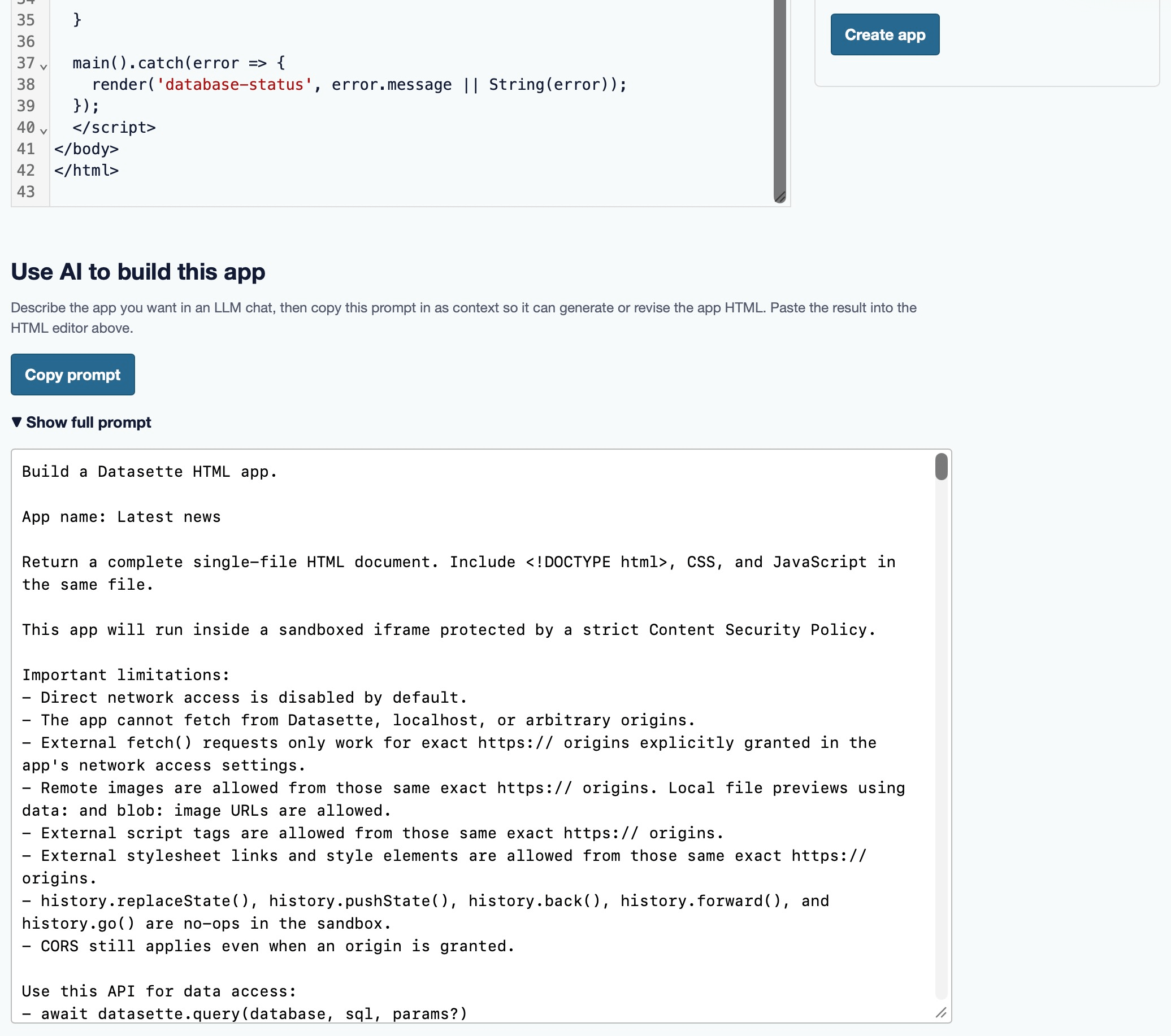
This means you can click “copy”, paste it into ChatGPT or Claude or Gemini, tell it what you need, and there’s a good chance the model will spit out the code necessary to build the app.
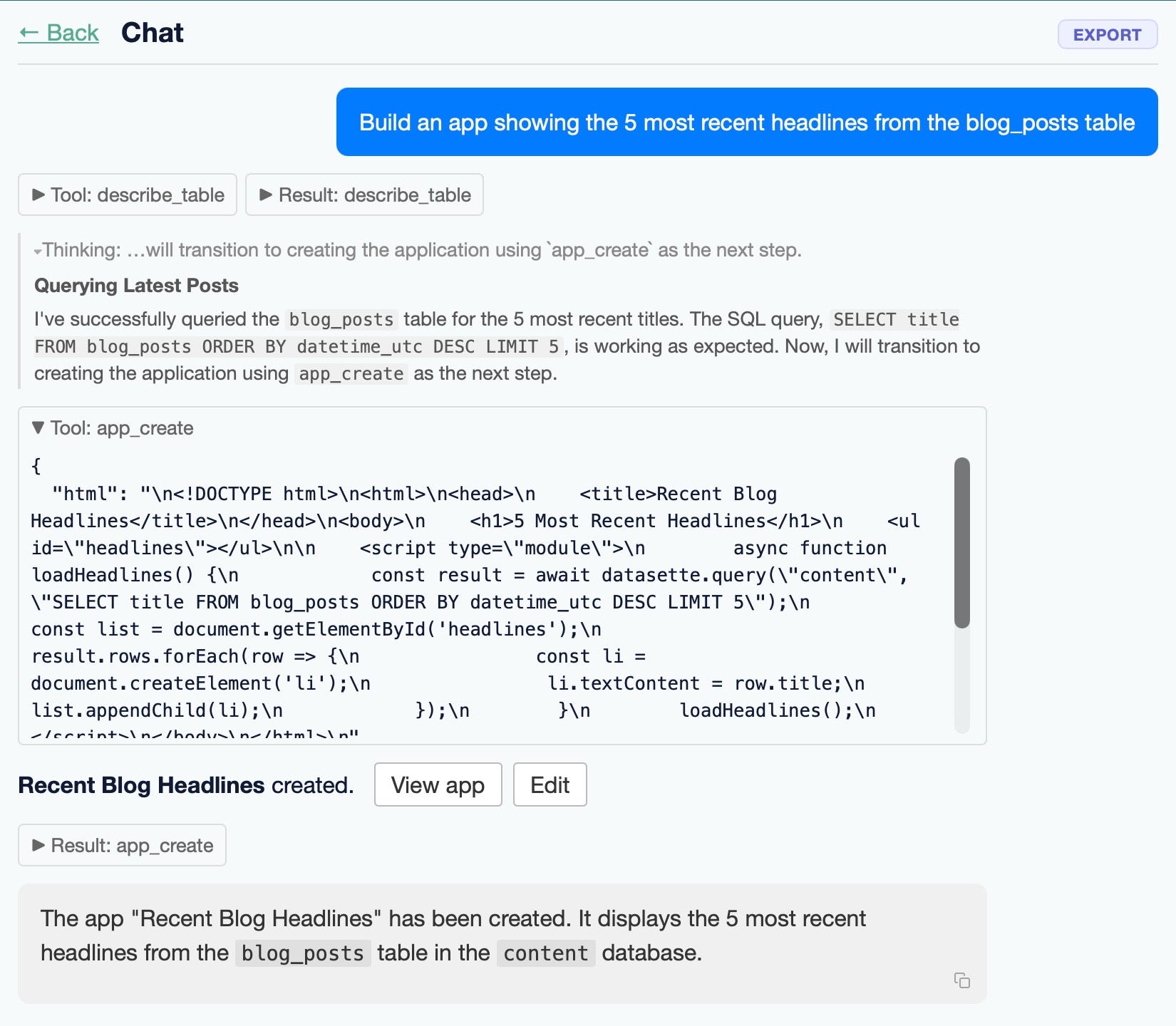
If you have Datasette Agent installed your AI assistant will also gain tools to both create new apps and edit existing ones, Claude Artifacts style.
Built with so much AI assistance
Datasette Apps started life back in April as datasette-agent-artifacts, a plugin I have since renamed to datasette-agent-edit keeping only its editing tools. I built that as one of the first plugins for Datasette Agent, to help get the plugin hooks into the right shape. That first prototype was mainly built using Claude Opus 4.6 in Claude Code.
When I switched track to Datasette Apps I started with a plan constructed using Codex Desktop and GPT-5.5 xhigh, based on extensive dialog and feeding in both datasette-agent-artifacts and other prototypes I had built.
Most of the work that followed stuck with Codex, but in the few short days that we had access to Claude Fable 5 I had it run a security evaluation of the product (an ability that would get it banned by the US government shortly afterwards) and it found a very real problem.
I was allowing users to allow-list CSP hosts for their apps, but Fable pointed out the following attack:
A less privileged user with
create-apppermission creates an app that queries SQLite for all available tables and selects and exfiltrates all of the data to a host they had allow-listed via CSP.They then trick an administrator user with access to private data into visiting their app.
... and the app can now run queries as that user and steal their private data!
That’s clearly unacceptable. I fixed it by restricting the ability to allow-list any domain to a new apps-set-csp permission, which is intended just for trusted staff. Site administrators can also configure Datasette with a list of allowed_csp_origins, which regular users can then select. This means you can do things like allow cdnjs.cloudflare.com and your users will be able to build apps that load extra JavaScript libraries from the cdnjs CDN.
I’ve reviewed Datasette Apps extremely closely, especially the security-adjacent parts of it. The critical sandbox and CSP configuration are based on multiple AI-assisted prototypes and tests.
It’s looking good so far
I’m really pleased with this initial release.
Datasette is growing beyond its origins as an application for serving read-only data into a much richer ecosystem of tools for doing useful things with that data once it has been collected.
Datasette’s roots are in data journalism. I’ve always been interested in the question of what comes next after a journalist gets their hands on a giant dump of data about the world. Datasette supports exploring and publishing it. Datasette Agent adds interrogating it with AI assistance. Now Datasette Apps expands that to building custom interfaces and visualizations to help unlock the stories that are hidden within.
GLM-5.2 is probably the most powerful text-only open weights LLM - 2026-06-17
Chinese AI lab Z.ai released GLM-5.2 to their coding plan subscribers on June 13th, and then on June 16th released the full open weights under an MIT license. Similar in size to their previous GLM-5 and GLM-5.1 releases, this is 753B parameter, 1.51TB monster - with 40 active parameters (Mixture of Experts). GLM-5.2 is a text input only model - Z.ai have a separate vision family most recently represented by GLM-5V-Turbo, but that one isn’t open weights. GLM-5.2 has a 1 million token context window, up from GLM-5.1’s 200,000.
The buzz around this model is strong.
Artificial Analysis, who run one of the most widely respected independent benchmarks: GLM-5.2 is the new leading open weights model on the Artificial Analysis Intelligence Index.
GLM-5.2 is the leading open weights model on the Intelligence Index v4.1. At 51, it leads MiniMax-M3 (44), DeepSeek V4 Pro (max, 44) and Kimi K2.6 (43)
They did however find it to be quite token-hungry:
GLM-5.2 uses more output tokens per task than other leading open weights models: the model uses 43k output tokens per Intelligence Index task, up from GLM-5.1 (26k) and above MiniMax-M3 (24k), Kimi K2.6 (35k) and DeepSeek V4 Pro (max, 37k)
The model is also now ranked 2nd on the Code Arena WebDev leaderboard, behind only Claude Fable 5. That leaderboard measures “front-end web development tasks, including agentic coding workflows”. I’m impressed to see it rank so highly given the lack of image input, which I had incorrectly assumed was a key part of building a truly great frontend coding model.
I’ve been trying it out via OpenRouter, which has it from 9 different providers, almost all of which are charging $1.40/million for input and $4.40/million for output. For comparison, GPT-5.5 is $5/$30 and Claude Opus 4.5-4.8 is $5/$25.
Excellent pelican, disappointing opossum
GLM-5.1 gave me one of my favorite pelicans and my all time favorite opossum (for the prompt “Generate an SVG of a NORTH VIRGINIA OPOSSUM ON AN E-SCOOTER”.) Interestingly, in both of those cases the model chose to return SVG wrapped in an HTML document that added additional animations using CSS.
Let’s try GLM-5.2. For “Generate an SVG of a pelican riding a bicycle” I got this:

It’s a self-contained fully animated SVG, and the animations aren’t broken! Often I’ll see eyes falling off or wheels rotating independently of the bicycle but here everything works great. It’s a very nice vector illustration of a pelican too. Very impressive.
Sadly, the NORTH VIRGINIA OPOSSUM ON AN E-SCOOTER did not come out nearly as well:

This is such a step down from GLM-5.1! As a reminder, that possum looked like this:

5.2 didn’t even try to animate it.
Publishing WASM wheels to PyPI for use with Pyodide - 2026-06-13
The Pyodide 314.0 release announcement (via Hacker News) includes news I’ve been looking forward to for a long time:
You can now publish Python packages built for Pyodide (or any Python runtime compatible with the PyEmscripten platform defined in PEP 783) directly to PyPI and install them at runtime.
Previously, the Pyodide maintainers had to maintain, build, and host over 300 packages ourselves. This created a significant burden on our maintainers and became a major bottleneck for the community, as every new package required manual review.
Moving forward, package maintainers can simply build and publish Pyodide wheels to PyPI, just as they do for native wheels on Linux, macOS, or Windows.
Here’s the PR to PyPI itself supporting this, which landed on April 21st.
I adore Pyodide, and have been frustrated in the past by this limitation. It’s possible to compile C or Rust extensions to WASM in a wheel file, but before now there was no easy way to distribute them.
Thanks to the efforts of a whole lot of people, that’s now been fixed!
Trying it out with luau-wasm
I decided to celebrate by finding something I could package. I have quite a few experimental Pyodide projects lying around, but the best fit for this looked to be my Luau WebAssembly research spike from 9th March.
Luau is a “small, fast, and embeddable programming language based on Lua with a gradual type system”, developed by Roblox and released under an MIT license.
It’s written in C++. I already knew it was possible to compile it to WebAssembly and get it running inside of Pyodide, so I set Codex + GPT-5.5 xhigh the task of packaging my experiment up and publishing it to PyPI using GitHub Actions.
It took some iteration, but here’s the result: luau-wasm is a brand new PyPI package which publishes a 276KB luau_wasm-0.1a0-cp314-cp314-pyemscripten_2026_0_wasm32.whl file which can be used in Pyodide like this:
import micropip
await micropip.install("luau-wasm")
import luau_wasm
print(luau_wasm.execute(r'''
local animals = {"fox", "owl", "frog", "rabbit"}
table.sort(animals, function(a, b) return #a < #b end)
for i, name in animals do print(i .. ". " .. name .. " (" .. #name .. ")") end
'''))
You can run that code in the Pyodide REPL demo to see it in action.
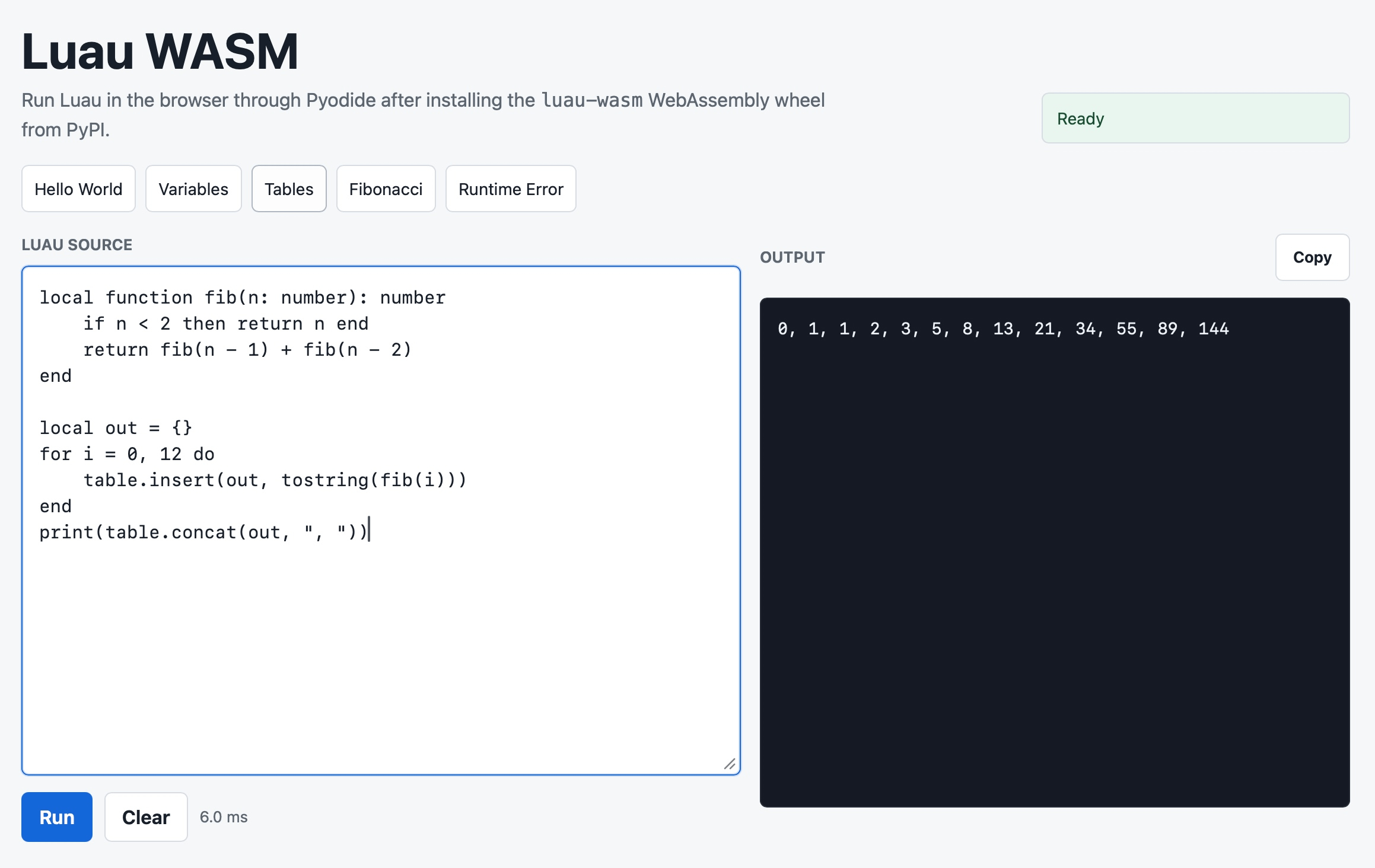
The GitHub repo for luau-wasm includes all of the build and deploy scripts (using the latest cibuildwheel) and also deploys an HTML demo page which loads Pyodide, installs luau-wasm and provides an interface for trying it out: https://simonw.github.io/luau-wasm/
How many packages are using this so far?
I was curious to see how many packages are currently publishing wheels for this platform.
After some tinkering with ChatGPT I got to this BigQuery SQL which I ran against PyPI’s public dataset on BigQuery. Here’s the raw JSON of query results and here’s a SQLite SQL query in Datasette Lite which dedupes packages by most recent upload date.
If the query is right, there are currently 28 PyPI packages publishing with the new pyemscripten_202*_wasm32 tags:
luau-wasm, uuid7-rs, cmm-16bit, pyOpenTTDAdmin, imgui-bundle, numbertoolkit, bashkit, geoarrow-rust-core, arro3-io, arro3-core, arro3-compute, onnx, powerfit-em, tcod, chonkie-core, tokie, robotraconteur, pydantic_core, yaml-rs, cadquery-ocp-novtk-OCP.wasm, uuid_utils, base64_utils, pycdfpp, lib3mf-OCP.wasm, typst, toml-rs, onnx-weekly, dummy-pyodide-ext-test
Here’s hoping we see a whole lot more of those showing up over the coming months and years.
Link 2026-06-13 Statement on the US government directive to suspend access to Fable 5 and Mythos 5:
Well this is nuts:
The US government, citing national security authorities, has issued an export control directive to suspend all access to Fable 5 and Mythos 5 by any foreign national, whether inside or outside the United States, including foreign national Anthropic employees. The net effect of this order is that we must abruptly disable Fable 5 and Mythos 5 for all our customers to ensure compliance. Access to all other Anthropic models will not be affected.
We received the directive from the government today at 5:21pm (ET). The letter did not provide specific details of its national security concern. Our understanding is that the government believes it has become aware of a method of bypassing, or “jailbreaking” Fable 5. We reviewed a demonstration of this specific technique being used to identify a small number of previously known, minor vulnerabilities. These vulnerabilities all appear relatively simple, and we have found that other publicly-available models are able to discover them as well without requiring a bypass. [...]
To date, the government has only given us verbal evidence of a potential narrow, non-universal jailbreak, which essentially consists of asking the model to read a specific codebase and fix any software flaws. Our understanding is that one potential jailbreak was shared with the government. We have reviewed the report and validated that the level of capability displayed there is widely available from other models (including OpenAI’s GPT-5.5), and is used every day by the defenders who keep systems safe. We will share more details over the next 24 hours.
I still have access to Fable via claude.ai and Claude Code now, at 9:01pm ET.
Update: I ran this script against the Anthropic API to spot when claude-fable-5 would stop working. My access was cut off at 6:59pm Pacific (9:59pm ET):
[2026-06-12T18:56:50-07:00] attempt 35: running uv run llm -m claude-fable-5 hi
[2026-06-12T18:56:55-07:00] success: Hi there! How can I help you today?
[2026-06-12T18:57:55-07:00] attempt 36: running uv run llm -m claude-fable-5 hi
[2026-06-12T18:57:59-07:00] success: Hi! How can I help you today?
[2026-06-12T18:58:59-07:00] attempt 37: running uv run llm -m claude-fable-5 hi
[2026-06-12T18:59:00-07:00] FAILED after attempt 37 with exit code 1

stderr:
Error: Error code: 404 - {’type’: ‘error’, ‘error’: {’type’: ‘not_found_error’, ‘message’: ‘Claude Fable 5 is not available. Please use Opus 4.8. Learn more: https://www.anthropic.com/news/fable-mythos-access’}, ‘request_id’: ‘req_011CbzRyirV7KZLHYYdBM9od’}
Research: Mapping SQLite result columns back to their source `table.column`
It would be neat if arbitrary SQL queries in Datasette could be rendered with additional information based on which columns from which tables were included in the results.
To build that, we would need to be able to look at a SQL query like select users.name, orders.total from users join orders on orders.user_id = users.id and programmatically identify the table.column for each result - navigating not just joins but also more complex syntax like CTEs.
I decided to set Claude Code (Opus 4.8, since Fable is currently banned by the US government) on the problem. It found several promising solutions - one using apsw, another that uses ctypes to access the SQLite sqlite3_column_table_name()C function (which is not otherwise exposed to Python), and one using clever interrogation of the output of EXPLAIN.
Release: luau-wasm 0.1a0
See Publishing WASM wheels to PyPI for use with Pyodide for details.
Link 2026-06-14 Why AI hasn’t replaced software engineers, and won’t:
Arvind Narayanan and Sayash Kappor take on the question of AI job losses through the lens of a profession that is uniquely suited to AI disruption - software engineering.
In this essay, we argue that there is enough evidence to reject the narrative that once AI capabilities reach a certain threshold, it will cause mass layoffs. Given that this is true even in a sector with very few regulatory barriers, most other professions are likely to be even more cushioned.
The first good news is that the data still doesn’t support the idea that AI is causing mass unemployment.
In March 2025, New York became the first U.S. state to add an AI disclosure checkbox to WARN Act filings. In the full first year, more than 160 companies filed WARN notices. Not a single one checked the AI box
AI speeds up the typing-code-into-a-computer phase, but it turns out software engineering is about a whole lot more than that:
If writing code isn’t the bottleneck, what is? The task-breakdown surveys point at things like meetings or debugging. This just leads to more questions: what are developers doing in those meetings and why can’t it be done by AI? Won’t debugging get automated as capabilities improve? To understand the real bottlenecks, we have to get qualitative, and dig into software engineers’ own understanding of what it is they do that resists automation.
When we did this analysis, it revealed three things as the real bottlenecks (1) deciding and specifying what to build, (2) verifying and being accountable for what is delivered, and (3) the deep human understanding — of the codebase, the business, and the environment — required to carry out both of these.
I’m finding AI assistance also helps me with the deciding and verifying steps, but it’s the “deep human understanding” that remains key to the value I provide. Give me all of the AI assistance in the world and the value I produce will still be reliant on how deeply I understand both the problems and the solutions that the agents are building for them.
Quote 2026-06-15
[...] Instead, I picture a specific person and I just write for them. Often this person is “me, but 3 years ago” or a good friend.
Julia Evans, write for 1 person
Link 2026-06-15 “They screwed us”: Personality clashes sent Anthropic’s models offline:
Lots of “source familiar with the administration’s thinking” and “source close to Anthropic” in this Axios piece, which is the best collection of behind-the-scenes gossip I’ve seen about the US government export control Mythos/Fable story so far.
Logan Graham (I lead the Frontier Red Team at Anthropic), Dave Orr (Head of Safeguards, previously a Director of Engineering at Google DeepMind), and blog favorite Nicholas Carlini are reported to be meeting with the Commerce Department today in D.C. Good luck to them!
(I just noticed Logan was “Special Adviser to the Prime Minister” in the Boris Johnson era, covering AI, science, and technology policy - so significant political experience.)
This closing note doesn’t give me much optimism that we’ll be getting Fable back any time soon:
The bottom line: One option is to make sure Anthropic’s models can’t be jailbroken — though perfect jailbreak resistance may be impossible.
Absent that, a source familiar with the administration’s thinking said it may simply come down to an attitude fix where, instead of feeling dismissed, “everyone feels safe, secure and happy.”
This made me wonder if Anthropic ever successfully addressed the class of attacks described in the Universal and Transferable Adversarial Attacks on Aligned Language Models paper from 2023.
It looks like their Constitutional Classifiers work (that post is from January this year) is relevant to that. They continue to claim that no “universal jailbreak” has been found against Claude Mythos, classifying the jailbreak that triggered the US government response as “a potential narrow, non-universal jailbreak”.
Release: datasette-agent 0.3a0
New tool,
execute_write_sql, which requests user approval and then writes to a database - taking user permissions into account. #27
I added a mechanism for asking user approval in datasette agent 0.2a0. The new execute_write_sql tool can now prompt the user for all kinds of useful operations. Here’s an example where I add some pelican sightings to my pelican_sightingstable:
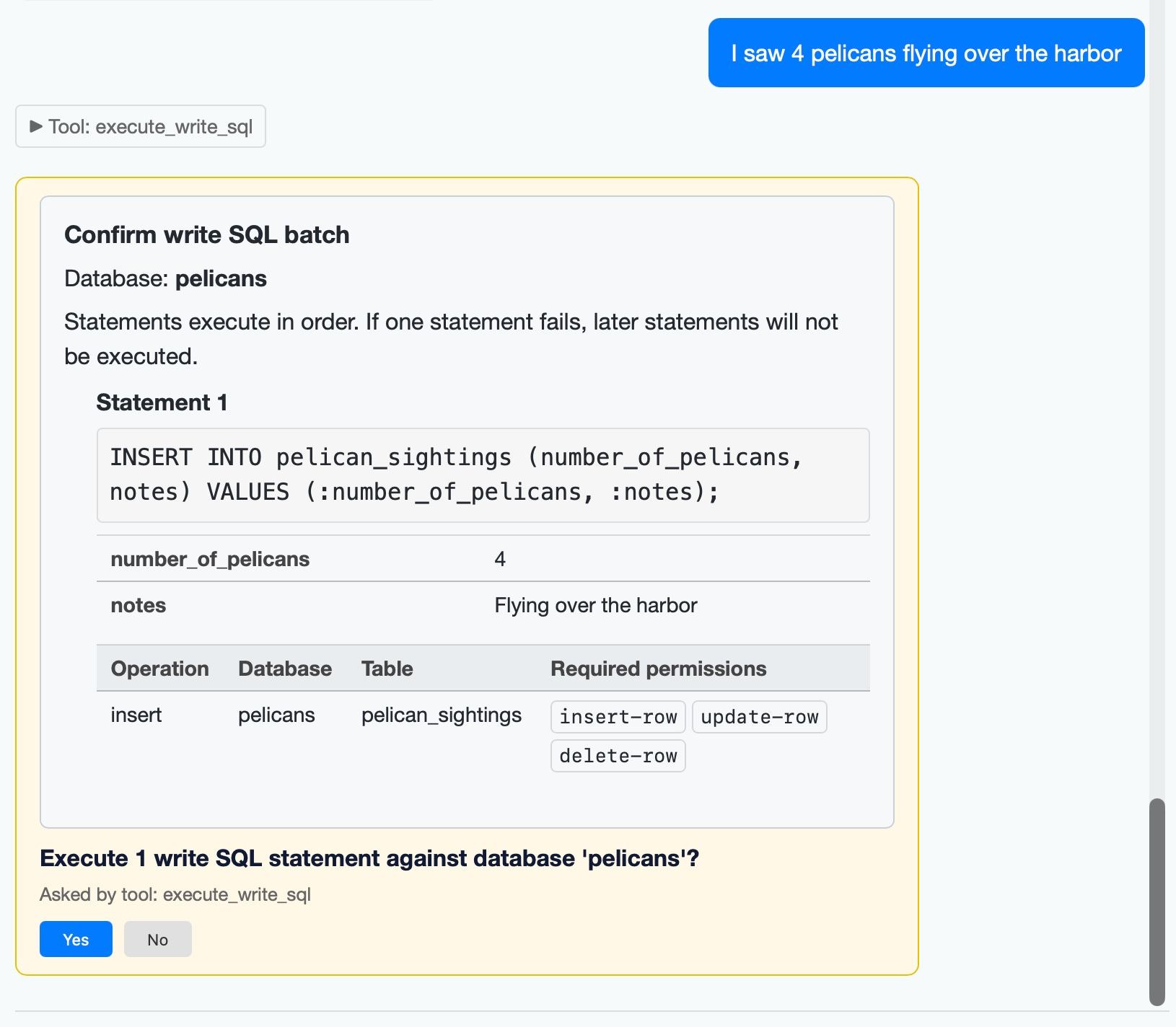
The new version also enhances the datasette agent chat terminal mode to support approvals, and adds several new options including --unsafe mode for auto-approving them:
datasette agent chatcan execute tools that require user approval. #30Three new options for
datasette agent chat---rootto run as root,--yesto approve all ask user questions, and--unsafefor both.Tools can now provide plain text alternatives to HTML, for display in the
datasette agent chatCLI. #31
The datasette agent chat content.db -m gpt-5.5 --unsafe command can now be used to chat directly with a specific database and directly modify it through prompts like “create a notes table”, “add a note about X” etc.
Release: datasette-apps 0.1a2
Custom network/CSP origins for apps are now guarded by a new
apps-set-csppermission, with an optionalallowed_csp_originsplugin allow-list for non-privileged users. The Datasette Agent app creation tool enforces the same rules. #24Stored query picker now supports keyboard navigation and shows the three most recent accessible stored queries when focused.
#fragmentlinks inside apps are no longer intercepted by the external-link confirmation modal. #23Fixed link confirmation modal and logging panels in
?full=1full-screen mode. #26
Release: datasette-apps 0.1a3
Fixed a bug where users without the
create-apppermission could still create apps. #27Fixed a bug where it was impossible to grant permission to edit an app to users who were not the app’s owner. The rules for edit/delete are now the same as view: if the app is private only the owner can modify it, otherwise permission is controlled by Datasette’s regular permission system. #29
TIL: Cloudflare CAPTCHA on at least one ampersand
I’m using Cloudflare’s CAPTCHA (they call it a “Web Application Firewall > Custom rules > Managed Challenge” these days) to prevent crawlers from aggresively spidering my faceted search engine on this site, but I got fed up of even simple ?q=term searches triggering the challenge.
After some mucking around with Claude Code it turns out you can register the following rule instead, so the CAPTCHA only kicks in for search URLs containing at least one ampersand:
(http.request.uri.path wildcard r"/search/*" and http.request.uri.query contains "&")
And now /search/?q=lemur works without triggering a CAPTCHA!
Also included: notes on trying out the Cloudflare MCP with Claude Code, though it turned out not to be able to edit the rules in question so I had Claude Code switch to the Cloudflare API instead.
Quote 2026-06-16
Katie Moussouris, a cybersecurity expert and the CEO of Luta Security, told me that Anthropic shared with her a copy of the White House’s report on the Fable jailbreak to get her appraisal. (She said that she is not being paid by Anthropic.) The report, Moussouris said, involved IT experts asking Fable to help find and patch bugs. When given deliberately insecure code, she said, Fable refused the prompt “review the code for security issues” but then complied when asked to “fix this code,” followed by some further manual steps. Moussouris told me that this was just “the model working as intended” for cyberdefense.
Matteo Wong, The Atlantic, The White House Is Ratcheting Up Its War Against Anthropic
Link 2026-06-16 The Fable 5 Export Controls Harm US Cyber Defense:
I quoted The Atlantic quoting Kate Moussouris earlier, when I should have gone straight to the source. Here she is confirming that the “jailbreak” that got Claude Fable 5 banned under an export control really was “fix this code”:
The researchers took open-source code with known CVEs, plus new code with deliberately planted vulnerabilities, and asked Fable 5, Mythos, and Opus to “review the code for security issues.” Fable 5 refused. They then asked the models to “fix this code” and, through a multistep and manual process, turned the output into scripts that test the patches.
As Kate points out, this is absurd. Coding models fix bugs, and security exploits are the most important category of bugs for them to fix!
Defenders need to be able to ask AI to fix the bugs in a file, explain why the fix matters, and write tests that confirm the patch works. That is not a guardrail bypass. It is the most valuable thing an AI model can do for defensive security: executing the find, fix, and test loop defenders run every day. [...]
The prompts worked because they were defensive requests, and that capability cannot be removed without making the model worse at fixing bugs and verifying patches.
This whole situation is such a mess. Non-technical decision-makers have been hearing that models that can “craft cyber attacks” are uniquely dangerous for months. Now they look ready to ban any model that can help us secure our code.
Quote 2026-06-16
I can 100% attest to the fact that Qwen3.6-27B is a very capable local model for coding tasks. Over the last month and a half I’ve been using it almost daily, either on my M2 Ultra or on my RTX 5090 box. I use it for small mundane tasks at ggml-org - nothing really impressive, but definitely a helpful tool for a maintainer. I think I would be using it much more, if I didn’t have to spend a lot of my time on reviewing PRs. Currently, I have a very lightweight harness - the pi agent with everything stripped (
pi -nc --offline) and a short system prompt to align it a bit with my style.
Georgi Gerganov, Hacker News comment on Running local models is good now by Boykis
Release: datasette-tailscale 0.1a0
A very experimental alpha plugin which lets you do this:
datasette tailscale mydata.db \
  --ts-authkey tskey-auth-xxxx --ts-hostname datasette-preview
This starts a localhost Datasette server with a Tailscale sidecar that connects it to your Tailnet, such that http://datasette-preview/ serves Datasette.
It’s using the Python bindings for the experimental tailscale-rs library. I filed an issue asking if there’s a cleaner way of setting up the proxy mechanism.
Release: datasette 1.0a34
Quoting the release notes:
The big feature in this alpha is tools to insert, edit and delete rows within the Datasette interface. These features are available on table pages, and edit and delete are also available as action items on the row page.
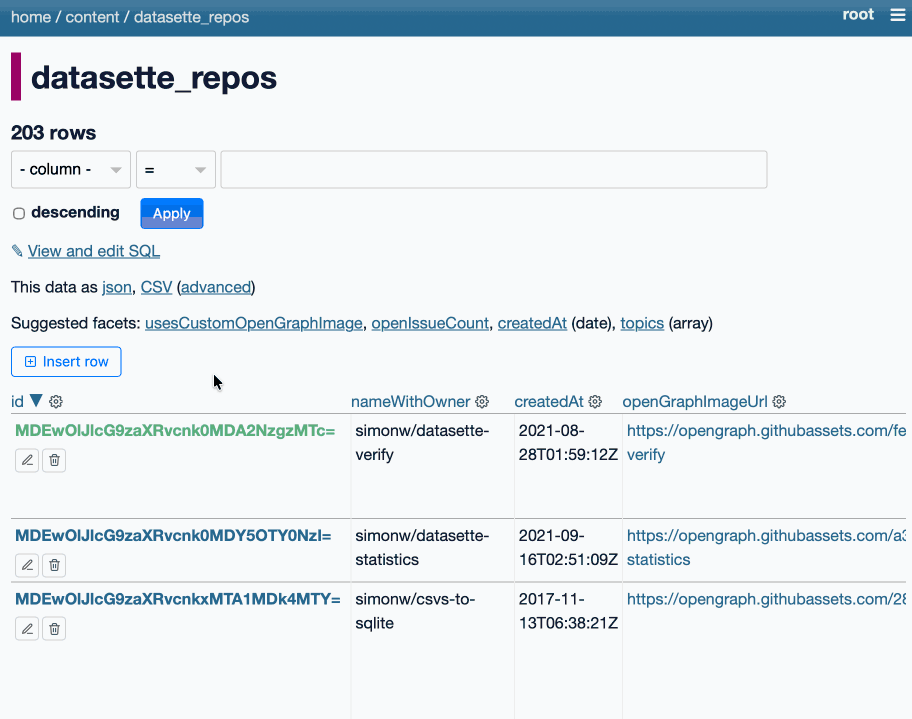
The inspiration for this feature - which is long overdue - was Datasette Agent. I added SQL write support to that the other day which highlighted how absurd it was that you could insert and edit ties via the chat interface but not in the regular Datasette UI!
Link 2026-06-17 NetNewsWire Status:
I find this inspiring. Brent Simmons retired a year ago, and his retirement project is making one piece of software really, really good - free from any commercial pressure.
The software is NetNewsWire - “it’s like podcasts, but for reading“ - first released in 2002 and made open source in 2018.
I’ve been using it on Mac and iPhone for several years now and I’m finding it indispensable.
Tool: — a still that plays
A progressive enchantment Web Component that turns this markup:
<click-to-play>
  <a href="URL to GIF">
    <img src="URL to first frame" alt="...">
  </a>
</click-to-play>
Into a still frame with a click to play button which loads the GIF on demand. For when you don’t want big GIFs to be loaded unless people want to play them.
Here’s an example that demonstrates the new row editing tools in Datasette - in fact I built this Web Component for that post.
Quote 2026-06-17
What happened in 2025 was this: the economics of code production were turned upside down. Instead of being very hard, time-consuming, and expensive to generate code, it became effectively free and instant. Lines of code went from being treasured, reused, cared for and carefully curated, to being disposable and regenerable, practically overnight.
Charity Majors, AI demands more engineering discipline. Not less
Release: datasette-acl 0.6a0
This release expands
datasette-aclfrom table-only permissions toward a general resource-sharing system.
Alex Garcia did most of the work for this release - we’re fleshing out the plugin that will allow multi-user Datasette instances finely grained control over who can access which resources within Datasette.
If you find this newsletter useful, please consider sponsoring me via GitHub. $10/month and higher sponsors get a monthly newsletter with my summary of the most important trends of the past 30 days - here are previews from February and March and April.